 I couldn't resist playing with Google's new Ngram Viewer, a program that an article in the The New York Times described as "Google's 500 Billion Word Haystack." Plug in some of the major communication media of the twentieth century and the Ngram Viewer returns the accompanying line graph (click on the graphic to see a full size version). The telephone and newspapers received considerable mention in English language books throughout the century, with a bit more attention around 1940 than at any other time. Mentions of radio soared during the World War II era. Mentions of television began to increase around 1950 and continued to do so until the year 2000. It comes as no surprise that mentions of the internet begin in the 1990s, a pointed reminder of how recent a phenomenon this everyday communication tool is. Although we may use the internet daily, we still use it for listening to the radio, watching television or reading newspapers, among other things.
Selasa, 28 Desember 2010
Long-term Media Trends--Evidence from Google's Ngram Viewer
I couldn't resist playing with Google's new Ngram Viewer, a program that an article in the The New York Times described as "Google's 500 Billion Word Haystack." Plug in some of the major communication media of the twentieth century and the Ngram Viewer returns the accompanying line graph (click on the graphic to see a full size version). The telephone and newspapers received considerable mention in English language books throughout the century, with a bit more attention around 1940 than at any other time. Mentions of radio soared during the World War II era. Mentions of television began to increase around 1950 and continued to do so until the year 2000. It comes as no surprise that mentions of the internet begin in the 1990s, a pointed reminder of how recent a phenomenon this everyday communication tool is. Although we may use the internet daily, we still use it for listening to the radio, watching television or reading newspapers, among other things.
Court Declares Telecom Law Unconstitutional
As reported in the Joongang Daily and widely in the local and international press, Korea's Constitutional Court yesterday ruled as unconstitutional a telecommunications law that had been used to punish the famous (or infamous, depending on your perspective) blogger Minerva. Minerva's case had been widely publicized in Korea and was the subject of an earlier post in this blog. It was viewed as an important case for freedom of expression and certainly highlighted the complex issues that Korea is facing in this area.
The Constitutional Court struck down the clause in the telecommunications law that had imposed a prison term of up to five years and a 50 million won fine ($43,500) for those who were deemed to spread false information on the Internet and mobile phones that would harm the public interest.In the 7-2 decision, the court said the clause was unconstitutional because it lacked a clear definition of “false” and “public interest” and imposed an excessively harsh punishment on violators.“The electronic communications law is unclear in meaning,” the court said in the ruling.
Civil liberties advocates said the ruling could be a significant milestone in preserving the right to freedom of expression. However, as noted in The Financial Times, some conservative civic groups worried aloud that it might contribute to chaos in cyberspace by tolerating online invective and hate mail against public figures.
The Constitutional Court struck down the clause in the telecommunications law that had imposed a prison term of up to five years and a 50 million won fine ($43,500) for those who were deemed to spread false information on the Internet and mobile phones that would harm the public interest.In the 7-2 decision, the court said the clause was unconstitutional because it lacked a clear definition of “false” and “public interest” and imposed an excessively harsh punishment on violators.“The electronic communications law is unclear in meaning,” the court said in the ruling.
Civil liberties advocates said the ruling could be a significant milestone in preserving the right to freedom of expression. However, as noted in The Financial Times, some conservative civic groups worried aloud that it might contribute to chaos in cyberspace by tolerating online invective and hate mail against public figures.
Senin, 27 Desember 2010
English-Teaching Robots Arrive in Korea
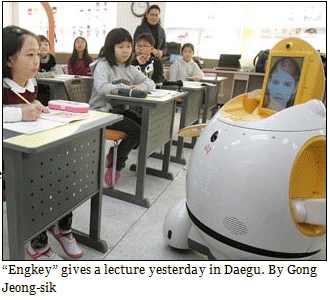 English teaching robots have arrived in South Korea! As reported in the Joongang Daily, the Daegu Office of Education introduced 29 robot teachers in 21 elementary schools. The 1-meter (3.28 feet) egg-shaped robot, named “Engkey” (an abbreviation of English key), spoke, asked questions and conversed in English with students, and even entertained the crowd by dancing to music. (Click on the accompanying graphic to see a full size version.)
From my point of view, one of the most interesting aspects of this experiment is that these robots are linked to real live teachers. These teachers control the machines by remote from the Philippines. They have cameras to record their faces - which show up on a flat panel screen that forms the robo-teacher’s face - and they can also see the Korean students through a camera installed in the robot. Basically, the robot is a rolling Internet link between students and teacher, although the human teacher can also command the robot to make human gestures with its arms and wheels.
No doubt this news is going to strike a chord with many of the expatriate English teachers now living and working in South Korea. It is also an interesting bit of evidence to support Korea's ambitious goals for the future of its robotics industry! Comments welcome!
Langganan:
Postingan (Atom)