 Two items in the news today provide a sure indication of continued media convergence and the maturation of the market for smartphones and mobile devices. The first item notes the change in distribution and sales of smart phones. In the past, manufacturers of mobile devices sold them only through a single mobile operator. Apple changed that pattern by making the iPhone available through both KT and SKT, and the other major handset and tablet manufacturers have followed suite, as reported by the Chosun Ilbo. Another article, in the Joongang Daily, reports that this week will see the introduction of a "deluge of new smartphone and tablet PC models." (click on the illustration to see a larger version)
Kamis, 28 April 2011
Proliferation of Smartphones and Tablets in Korea
Two items in the news today provide a sure indication of continued media convergence and the maturation of the market for smartphones and mobile devices. The first item notes the change in distribution and sales of smart phones. In the past, manufacturers of mobile devices sold them only through a single mobile operator. Apple changed that pattern by making the iPhone available through both KT and SKT, and the other major handset and tablet manufacturers have followed suite, as reported by the Chosun Ilbo. Another article, in the Joongang Daily, reports that this week will see the introduction of a "deluge of new smartphone and tablet PC models." (click on the illustration to see a larger version)
Minggu, 24 April 2011
Are Smart Phones Tracking Users in Korea?
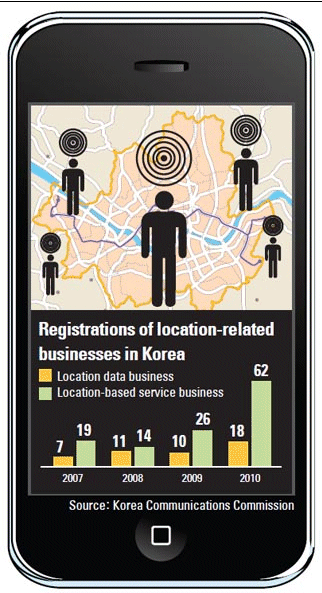 The Joongang Daily this morning carried an article with the accompanying data (click on the graphic to view a full sized version) on the growth of location-based data and location-based service businesses in Korea. Not surprisingly, the chart shows a rather dramatic increase in the business between 2009 and 2010. This is exactly what we would expect, given that Apple's iPhone was delayed in coming to the South Korean market and did not arrive here until November of 2009. While location-data businesses, which include Apple and Google, collect location data, location-based services businesses use that data for various services such as logistics, transportation, or emergency services.
LBS is considered a rising business, and not just in Korea. Research firm Gartner said the market for location-based services - currently worth $2.9 billion - will to rise to $8.3 billion in 2014.
Jumat, 22 April 2011
How Widespread is Mobile Phone Use in North Korea?
The English online version of The Chosun Ilbo this morning has a short, but fascinating article, entitled "How Widespread is Mobile Phone Use in North Korea?" As readers of this blog will know, I've been following not only the extent of mobile phone usage in North Korea, but also its implications, in posts over the past several years. According to The Chosun Ilbo article, the mobile phone penetration rate in North Korea is only about 1.3 percent, far lower than South Korea's 103.9 percent, but the average usage time amounts to 300 minutes, more or less the level of South Korea's. Hwang Sung-jin of the Korea Information Society Development Institute, said this is because of brisk usage among high-ranking North Korean officials. The article also quotes Suk Ho-ick of KT, the chairman of the IT Unification Forum, on North Korea's efforts to control the use of mobile phones.
Langganan:
Postingan (Atom)